392%
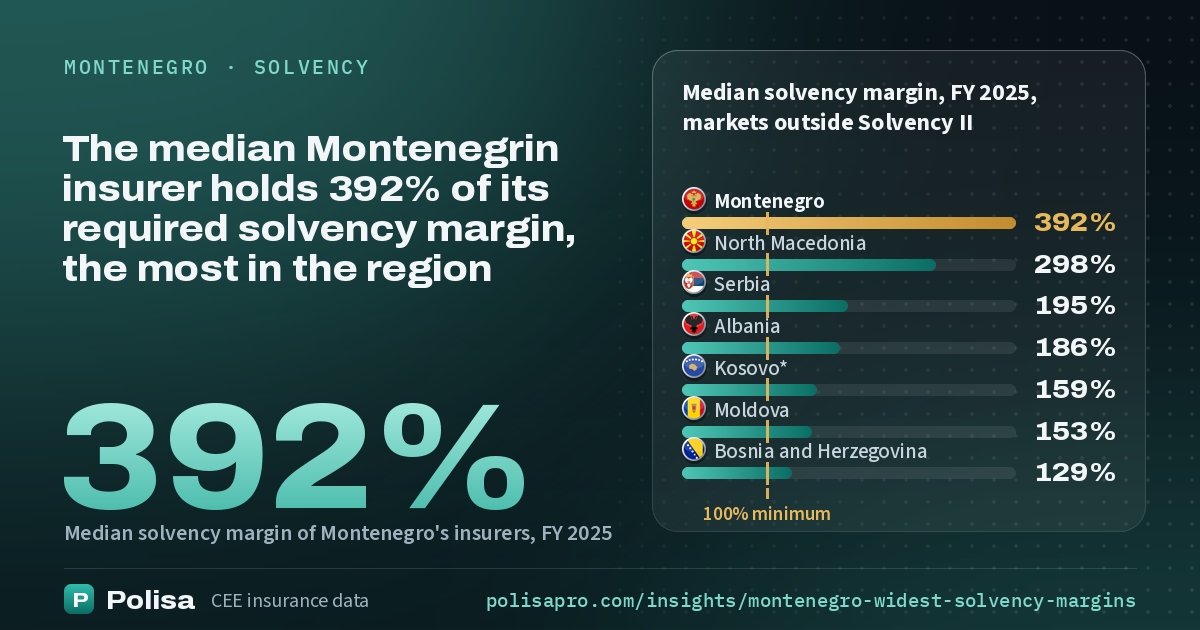
The median Montenegrin insurer holds 392% of its required solvency margin, the most in the region
All nine Montenegrin insurers published a solvency margin for 2025, and every one holds at least twice the requirement; the median is 392%, the highest of the 18 markets. Montenegro is outside Solvency II: the margin is a simpler measure than the SCR ratio, so the figure says the buffer is wide, not that it is comparable.
Of the seven markets outside Solvency II that publish a local solvency margin, Montenegro's insurers hold the widest buffer: a median of 392% of the required margin in 2025, against 298% in North Macedonia and from 129% in Bosnia and Herzegovina to 195% in Serbia in the other five. It is also above the highest Solvency II median, Slovenia (261%), though the two measures are not the same thing.
The buffer is wide across the market, not only at the top. The lowest ratios are Sava (207%) and UNIQA neživotno (211%); the highest is GRAWE, a life insurer (956%). Lovćen, the largest insurer with 28% of premium (34% in 2021), holds 296%. In no year since 2021 has an insurer been below twice the requirement, and the median has risen from 340%.
The highest ratios are at the life insurers: three of the four hold more than any of the five non-life insurers, which run from Sava (207%) to Generali (466%). The requirement is a fixed share of reserves for life business and of premium or claims for non-life, so a small book with capital above the legal minimum carries a high ratio.
The ratio is the available against the required solvency margin as the supervisor (ANO) and the insurers publish them, under Montenegro's own rules. The requirement does not depend on the risks an insurer runs, as the SCR does, so a 392% margin is not a 392% SCR ratio; the chart marks these markets as “margin” and lists them after the Solvency II markets. The market is small, €148m of premium from nine insurers, with no branches or cross-border business.
The numbers behind it
More insights
Solvency ratios will rise from 2027 without insurers becoming stronger
+3.1 ptsThe Solvency II review, which applies from 30 January 2027, cuts the risk margin in insurers' technical provisions: the lower cost-of-capital rate alone takes about 21% off it. Own funds rise with it, and so do SCR ratios in the eleven Solvency II markets Polisa covers, before any change in the business. On the insurers' 2025 balance sheets, that cut alone would lift the median insurer's ratio by 3.1 points, before tax.
Capital buffers grew in Slovenia and Croatia and narrowed in Latvia and Slovakia
+55 ptsThe median SCR ratio of Slovenian insurers rose from 206% in 2021 to 261% in 2025, and of Croatian insurers from 185% to 231%. In Latvia it fell from 162% to 135%, in Slovakia from 191% to 166%.
Latvian and Romanian insurers hold the thinnest capital buffers
135%Median SCR ratio of Latvia's insurers in 2025, the lowest of the eleven Solvency II markets; Slovenia (261%) and Croatia (231%) hold the most. Every insurer with a 2025 Solvency II report is above the 100% minimum.
Pages behind it


When the figures change
Every data update is listed with its date, newest first: new figures, corrections and what they changed.
What changedCiteCite this pageThe reference in APA style and as BibTeX, each with a copy button, and the terms of reuse
Polisa compiles the figures; the original sources are named on this page and on the method page.
Polisa. (2026). The median Montenegrin insurer holds 392% of its required solvency margin, the most in the region [Data version 2026-11-11.13378f]. Retrieved November 11, 2026, from https://polisapro.com/insights/montenegro-widest-solvency-margins
BibTeXShow entry
@misc{polisa_insights_montenegro_widest_solvency_margins_2026,
  author       = {{Polisa}},
  title        = {The median Montenegrin insurer holds 392% of its required solvency margin, the most in the region},
  year         = {2026},
  version      = {2026-11-11.13378f},
  howpublished = {\url{https://polisapro.com/insights/montenegro-widest-solvency-margins}},
  note         = {Accessed 11 November 2026}
}
Reuse: Polisa's compilation CC BY 4.0 · source data under each publisher's terms, see Method.