+3.1 pts
Solvency ratios will rise from 2027 without insurers becoming stronger
The Solvency II review, which applies from 30 January 2027, cuts the risk margin in insurers' technical provisions: the lower cost-of-capital rate alone takes about 21% off it. Own funds rise with it, and so do SCR ratios in the eleven Solvency II markets Polisa covers, before any change in the business. On the insurers' 2025 balance sheets, that cut alone would lift the median insurer's ratio by 3.1 points, before tax.
The review, Directive (EU) 2025/2 and Delegated Regulation (EU) 2026/269, is the first large revision of Solvency II. The risk margin, the part of technical provisions that stands for the cost of handing an insurer's obligations over to another insurer, is calculated with a cost-of-capital rate of 4.75% instead of 6%, which on its own cuts it by about 21% (4.75 against 6; the same figure is quoted for this step in the notes the regulation page cites). The delegated regulation then adds a factor that shrinks projected risks over time, capped at half, which cuts it further. Lower provisions mean higher own funds, and the SCR ratio, own funds against the capital requirement, goes up with them.
The requirement itself can fall too: long-term equity holdings may carry a 22% charge instead of 39% where an insurer can show it would not have to sell them for five years under stress. Insurers with large equity portfolios gain the most from that part.
This is the base the change starts from. In 2025 the median insurer among the 193 with a Solvency II report in these markets held own funds of 1.9 times its requirement (192%). The national medians ran from 135% in Latvia to 261% in Slovenia, and no insurer was below the 100% minimum.
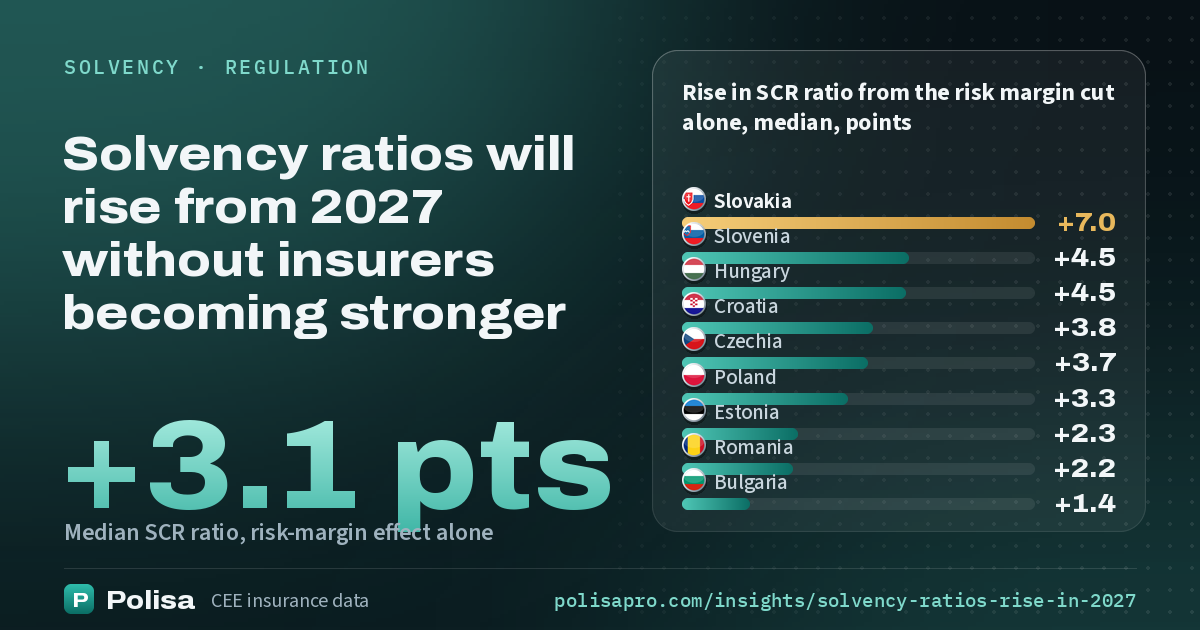
How much the cut in the risk margin adds on its own can be estimated from the insurers' balance sheets. Polisa read the risk margin at the end of 2025 (template S.02.01 of the solvency report) for 169 of the 193 insurers. Had it been 21% lower, own funds would have been higher by that amount before tax and, with the requirement unchanged, the median insurer's SCR ratio would have been 3.1 points higher. The median ratio of these insurers moves from 195% to 199%. The chart shows the median rise in each market; the table sets it beside the market's median ratio before and after.
The gain is largest in Slovakia (+7.0 points), Slovenia (+4.5) and Hungary (+4.5) and smallest in Bulgaria (+1.4) and Romania (+2.2). It depends on how large the risk margin is against the requirement, and that is mostly a matter of business mix: insurers that write mostly life business, whose obligations run for decades, gain a median of 4.1 points, the others 2.4. The largest gains are at ČSOB Poisťovňa in Slovakia (+17.0 points) and Prva osebna zavarovalnica in Slovenia (+16.2 points).
This is an illustration, not a forecast. It shows the risk-margin effect only, before tax: deferred tax takes back part of the rise in own funds. It applies the 21% from the lower cost-of-capital rate to every insurer and leaves out the time factor, whose effect depends on how each insurer's risks run off, so the actual rise is likely to be larger; it also leaves out the lower charge on long-term equity holdings and the changes to the volatility adjustment. Latvia and Lithuania are not covered yet (the table shows no estimate for them), and nine more insurers are left out because Polisa does not have the figure from their reports. Each insurer's page shows its own estimate in the Solvency section.
For the figures on Polisa: the solvency reports for 2026, published in spring 2027, still follow the current rules. The first reports under the new rules are those for 2027, due in May and June 2028, when an insurer's own report is due 18 weeks after the year end instead of 14. Polisa will mark the break in its solvency series from 2027, so that the rise is not read as insurers becoming stronger.
The review also changes the report itself: it is split into a part for policyholders and a part for professionals, its balance sheet has to be audited except at small and non-complex insurers, and those insurers will report less. The regulation page lists the dates and the sources.
The numbers behind it
More insights
The median Montenegrin insurer holds 392% of its required solvency margin, the most in the region
392%All nine Montenegrin insurers published a solvency margin for 2025, and every one holds at least twice the requirement; the median is 392%, the highest of the 18 markets. Montenegro is outside Solvency II: the margin is a simpler measure than the SCR ratio, so the figure says the buffer is wide, not that it is comparable.
Capital buffers grew in Slovenia and Croatia and narrowed in Latvia and Slovakia
+55 ptsThe median SCR ratio of Slovenian insurers rose from 206% in 2021 to 261% in 2025, and of Croatian insurers from 185% to 231%. In Latvia it fell from 162% to 135%, in Slovakia from 191% to 166%.
Latvian and Romanian insurers hold the thinnest capital buffers
135%Median SCR ratio of Latvia's insurers in 2025, the lowest of the eleven Solvency II markets; Slovenia (261%) and Croatia (231%) hold the most. Every insurer with a 2025 Solvency II report is above the 100% minimum.
Pages behind it
When the figures change
Every data update is listed with its date, newest first: new figures, corrections and what they changed.
What changedCiteCite this pageThe reference in APA style and as BibTeX, each with a copy button, and the terms of reuse
Polisa compiles the figures; the original sources are named on this page and on the method page.
Polisa. (2026). Solvency ratios will rise from 2027 without insurers becoming stronger [Data version 2026-11-11.13378f]. Retrieved November 11, 2026, from https://polisapro.com/insights/solvency-ratios-rise-in-2027
BibTeXShow entry
@misc{polisa_insights_solvency_ratios_rise_in_2027_2026,
  author       = {{Polisa}},
  title        = {Solvency ratios will rise from 2027 without insurers becoming stronger},
  year         = {2026},
  version      = {2026-11-11.13378f},
  howpublished = {\url{https://polisapro.com/insights/solvency-ratios-rise-in-2027}},
  note         = {Accessed 11 November 2026}
}
Reuse: Polisa's compilation CC BY 4.0 · source data under each publisher's terms, see Method.